A bit of inspiration..

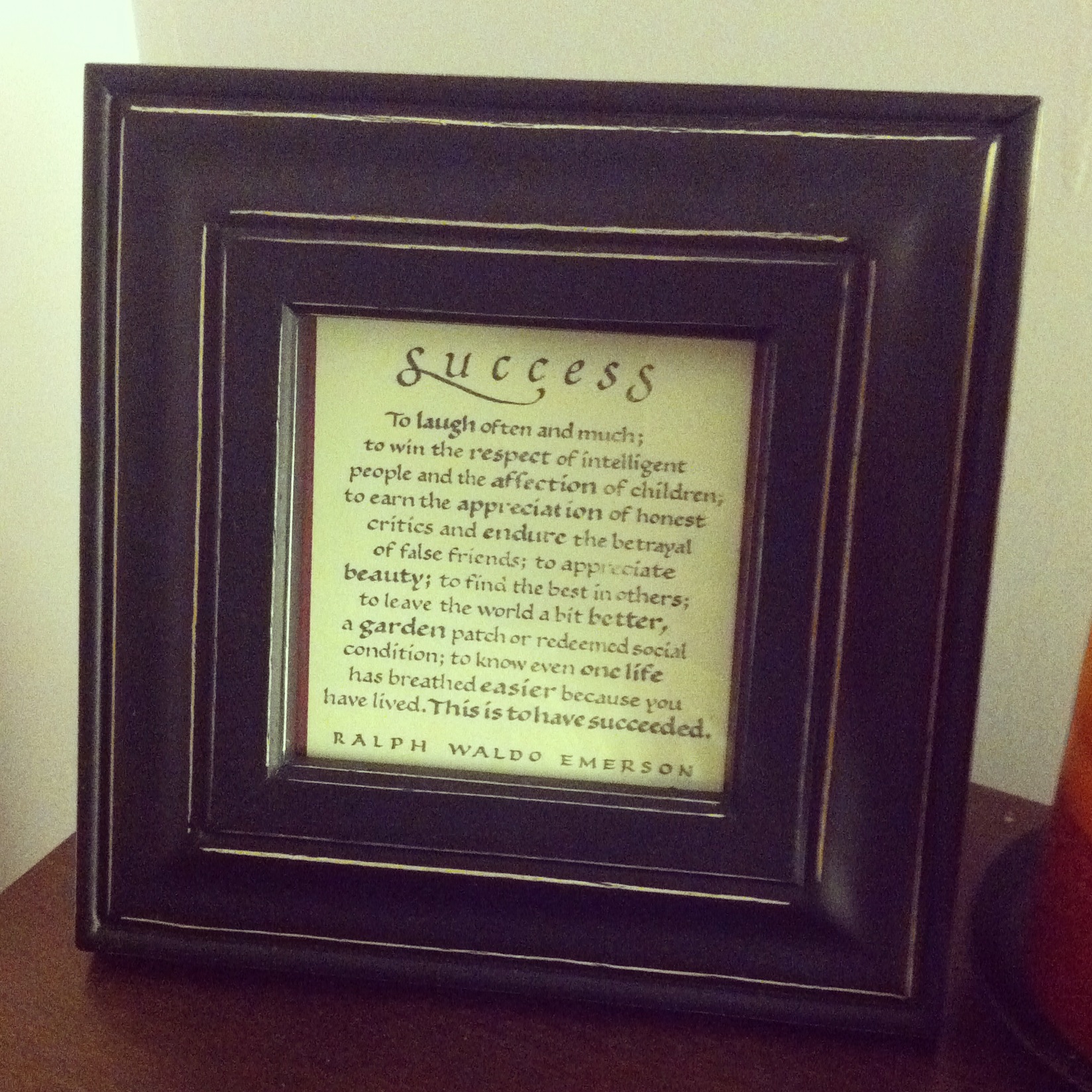
My Great-Aunt (who is now 97!), gave me this handmade card when I graduated high school.  Though she hadn't made it herself, even then I thought the stamped Emerson quote was just beautiful.  

Success by Ralph Waldo Emerson Keepsake

Just about 10 years later I still had the card, and this summer I finally framed it with her signature safe on the back.  It sits on my desk now, reminding me that success comes in many forms.  

Success

To laugh often and much;
to win the respect of intelligent
people and the affection of children;
to earn the appreciation of honest
critics and endure the betrayal
of false friends; to appreciate
beauty; to find the best in others;
to leave the world a bit better,
a garden patch or redeemed social
condition; to know even one life
has breathed easier because you
have lived.  This is to have succeeded.

Ralph Waldo Emerson

KEEP UP WITH BIRCH LANDING HOME
|  Etsy  |  Facebook  |  Instagram  |  Pinterest  |  Bloglovin'  |  Hometalk  |

Turn a Starbucks Bottle into a Milk Bottle Vase

Ever notice that the silhouette of those Starbucks bottles are very much like an old-fashioned milk bottle?  I'm sure the real reason is smart marketing, but an ever better reason is for you to turn that bottle into a milk bottle vase!  

How to turn a Starbucks bottle into a milk bottle vase tutorial

Materials:  

  • Starbucks glass bottle, with lid (which means you have to drink one of those delicious coffee drinks.. darn)
  • white or cream acrylic paint
  • cardboard

How to:  

First drink a Starbucks (most difficult part of the job right here).  Then remove the labels and wash the bottle thoroughly, inside and out.  You should be able to get the glue residue and expiration mark off the bottle with a scrubby sponge and dish soap.  Rinse the cap and save.  

Glass Starbucks bottle and acrylic paint

After the bottle has completely dried, squirt a decent amount of acrylic paint into it and replace the cap.  Swirl and shake the bottle until the paint has completely coated the inside of the bottle, adding more paint if necessary.  

Coating the inside of the Starbucks bottle with paint

Remove the cap and pour the excess paint back into your paint bottle.  

Next set bottle upside down on the cardboard for about 30 seconds then pick straight up, set back down in a different spot, and repeat several more times until you seem to have most of the excess paint out and a nice even coat on the inside of the bottle.  

Removing excess paint from the Starbucks bottle

Put bottle back upright to dry so the paint doesn't drip and pull away from the bottom and also so that air can get inside.  At this point I brought it inside the garage to dry - didn't want any curious grasshoppers falling in!  

Let dry about 48 hours.. it can take a surprisingly long time to dry due to the small opening of the bottle.  


Once completely dry, place on a sunny windowsill and admire.  (Note:  this vase is for decor purposes only.  If you put water in it for cut flowers the acrylic paint may start to lift off the glass after a while.. just something to keep in mind.  You may want to consider using fake flowers.)  

Starbucks country milk bottle vase on a sunny windowsill

You could even dress these up a bit with some gingham or burlap ribbon.  They are so easy to make and could be used for all sorts of things such as small centerpieces or accents for a bridal or baby shower.  

KEEP UP WITH BIRCH LANDING HOME
|  Etsy  |  Facebook  |  Instagram  |  Pinterest  |  Bloglovin'  |  Hometalk  |

Our Top Baby Registry Must-Haves (many will surprise you!)

Getting ready for a new baby means.. a lot of stuff.  Like, a boatload.  Some stuff you’ll hardly ever use, and others you just couldn’t live without. 
Read on for some of our favorite baby registry must-haves - some will surprise you! 
| This post contains affiliate links |

Top Baby Registry Must-Haves you don't think of
  1. Coconut Oil - This will become your go-to every time baby has dry skin or a rash. It helps treat cradle cap, dry skin, various diaper rashes, and heat rash. It's is a natural anti-fungal and antibacterial so it heals, moisturizes, and helps keep the issue from coming back.
    (FYI - coconut oil can be expensive.. the place where we've found the best deal has been in-store at Trader Joe's.)

  2. Aden+Anais Swaddle Blankets – nearly all babies love to be swaddled, and these blankets are perfect. They’re made of very breathable muslin which helps ensure baby doesn't overheat and are also over-sized so you always have plenty of material to work with.
    When baby no longer wants to be swaddled, they make perfect lightweight stroller blankets.

  3. Sophie the Giraffe - I thought this was the most ridiculous thing at first (nearly $20 for a little rubber giraffe? Really?!), but our daughter absolutely loves it! It was one of the first toys she could hold and play with thanks to it's long neck and legs, and all of it's different parts and textures give her a lot of options for teething.
    Now that she's crawling she loves holding on to Sophie and squeaking her against the floor as she goes along. It's become one of our daughter's favorite toys, though our dog did take some convincing that it wasn't for her.

  4. Convertible Pack 'N Play (with bassinet + changing table) - In the first few weeks when you're sore and beyond exhausted, you're going to want some place close to put your baby down or change her. These convertible pack 'n plays are ideal, but don't get too carried away with them! When we were first comparing all our options we were tempted to get the most expensive one will all the bells and whistles, but instead settled for a mid-range model and I'm so glad we did. Our little baby outgrew the bassinet within weeks so if we had spent extra money on one with an extra-fancy bassinet it would have been for naught. As a whole though these pack 'n plays grow with baby, so this is a purchase you'll be using for a long time.

  5. Insulated Lunch Box or Small Cooler - Bottle feeding or breast feeding, at some point you will need to take milk or formula with you. Whether you choose a novelty lunch box that will take your little one into daycare and preschool or an ordinary small cooler, having someplace to keep milk and first foods cold on the go is essential.

  6. Baby Merlin's Magic Sleepsuit - This is another one of those things I thought was a total gimmick at first but after weeks of our little one walking up no less than 15 times a night (oh how I wish I was exaggerating) and refusing to nap during the day, I gave it a try and it certainly was magical!
    The Sleepsuit helps transition your little one when they no longer want to be swaddled, but are still being awoken by their Moro reflex. It allows them to sleep on their back in a stretched out position but the puffy padded suit helps "muffle" their startles, keeping them feeling cozy and safe and allowing them to fall back asleep on their own. The suit comes in two sizes (3-6 months and 6-9 months) and should no longer be used when baby is able to start to roll over in the suit.
    For us this suit was a sanity saver and got our little one's sleep back on track. It also was instrumental in helping us establish naps and start our daughter on a schedule when she was a few months old.

  7. Stain Removers - Babies are messy, and you don't realize just how much so until you have one.
    So far Seventh Generation Natural Stain Remover Spray has been able to take down every laundry stain we've thrown at it - even set-in stains that have already been through the wash once already are no match for this spray.
    For the instances when baby poops, pees, or spits up on things that can't go through the washing machine (like the carpet or the couch) Bi-O-Kleen Bac-Out Stain and Odor Eliminator does a great job at lifting the stains and smells out.

  8. Jogging Stroller - It doesn't matter if you're or runner or have never worked out a day in your life - get the jogging stroller over the regular stroller with the little wheels.
    After going for walks with friends that have regular strollers, it made me all the more thankful for our jogger! Our BOB stroller navigated the walking path and sidewalks with ease but for our small-wheeled stroller friends, relatively small cracks and uneven parts of the sidewalk became like hitting a brick wall with stroller, baby, and mom coming to an abrupt halt.
    And don't let price and compatibility deter you - my sister-in-law found our nearly $400 BOB stroller on Craigslist for only $40, so don't be afraid to buy used! Also most joggers have car seat adapters available so you can still use your travel system like you would with a regular stroller.

  9. The Baby Book by Dr. Sears - Ever wish babies came with directions? This is probably as close as you'll come. This easy-to-read book covers all the basics and more and is a great reference for just about everything that will come your way.
    While you're pregnant I also highly recommend reading The Pregnancy Book and The Birth Book (also of the Sears Parenting series). I read several pregnancy/labor books while expecting and these were the most thorough books hands-down. And while they were a little too "touchy-feely" for my taste at times, I felt as though they really helped me prepare for and understand my pregnancy and labor.

  10. Mattress Protection (for your mattress) - It's a given to get mattress covers for the baby's mattress, but until someone suggested one for our mattress too it never crossed my mind.
    In your last trimester get a good-quality, non-crinkly mattress cover for your own bed. That way in case your water breaks in bed, you're protected. Then even after baby is born, leave it on because at some point baby will poop, pee, or throw-up in your bed. It will happen more than once, trust me. And do you really want to ruin that $400 mattress? Didn't think so.

  11. Fan - White noise can help lull a baby to sleep and good air circulation can help reduce the risk of SIDS, so having a fan near wear your baby sleeps is a great idea. Some people swear by sound machines to help their baby to sleep, but personally the thought of whale sounds going for hours on end gives me a headache.
    Whatever you decide to do, have a little white background noise and make sure baby's room is well-ventilated.

  12. Infant Carrier – there are lots of great ones out there. I suggest going to a local Babies ‘R Us or baby boutique and try some on to see what features you like and don’t like. Some people really like a structured carrier (like an Ergo or Boba), and others prefer the ones made of stretchy material (like a Moby wrap). Personally, I prefer the structured carrier.. it’s definitely a lot easier to take on and off when you’re out and about. Just make sure not to get one that's considered a "crotch-dangler" - they're bad for baby's hips!
    Whatever you choose, baby-wearing is not only great for bonding but it’s a HUGE sanity saver. It allows you to be able to still get things done around the house when your little one won’t let you put them down.

That's our list of our top baby must-haves, but of course there are a million other things you'll need - diapers, wipes, bottles, breast pumps, diaper pail, saline drops, co-sleeper or bassinet, crib, high chair, car seat... The list goes on and on but we hope we gave you some ideas for things that you might not have thought of.  
It can be a hard and exhausting job, but motherhood is the most rewarding thing you'll ever do.  Good luck, Mama - you'll do great!  


KEEP UP WITH BIRCH LANDING HOME
|  Etsy  |  Facebook  |  Instagram  |  Pinterest  |  Bloglovin'  |  Hometalk  |

Baby's First Foods: The Basics {Free Printable Chart}

Starting solids is a huge step, especially for first-time parents like us.  So many questions, so many rules, so much to keep track of in the beginning!  Here we thought we'd share some of the basics, our go-to resources, and a handy chart to keep track of your baby's first foods.  | This post contains affiliate links |

BabysFristFoodsTitle.jpg

Disclaimer:  The info I am sharing is based on my own experiences; I am not a medical professional.  Always double check with your pediatrician before starting solids and get their professional opinion on the best way to introduce new foods to your little one.  Please also note this post was originally published in 2014 and some "best practices" may have changed.  Always check with your child's pediatrician for their recommendations and advice.  

Most pediatricians recommend starting solids between 4-6 months of age (closer to 6 months is supposed to be best).  Baby must be able to hold their head independently and ideally the baby has also started to show an interest in food.  It's important to get the okay from your pediatrician first before starting solids.  

In the past baby's first food was always rice cereal, but that's not the case anymore.  Just about any pureed food that's considered "non-allergenic" and has been thinned down sufficiently can be given.  In general, it's best to work from a pre-determined list of typical "first foods" - these are foods that are least-likely to cause allergies or reactions in your little one.  Make sure the foods are well-pureed and thin them down with breast milk, formula, or water - the thinner the better in the beginning!  Once baby gets used to swallowing their thinned food, you can add less liquid and make the food increasingly thicker.  

Follow your baby's lead when feeding.  If they turn their head or push the spoon away, they're finished - don't pressure them.  And don't worry if baby seems to hate their dinner, it's been said that a baby needs to try a food at least 10 times before they're sure if they really hate it or love it.  If baby really hates those pureed pears wait a few days or a few weeks before trying it again, you may be surprised how much he loves it the next time!  

Shop My Amazon Favorites Here

Always introduce new foods individually at least 3 or 4 days apart to make sure your baby doesn't have any kind of reaction.  Keep track of any symptoms or side affects no matter how insignificant, as it may be a coincidence or be related to the food.  If you notice your baby is extra fussy or gassy, for example, write that down and see if she has the same reaction next time she has that particular food.  If your baby breaks out in a rash, has a change in breathing, or any other kind of severe reaction call the pediatrician immediately!  

Fresh is best when it comes to baby food!  Making your own pureed baby food is quick and easy - all you need is a steaming basket, blender, and baby food storage containers.  Steam the fruit or veggies until soft then blend until smooth, using the cooking water to thin as needed, then store in baby food storage containers.  Breast milk storage bags can also be used to store baby food, and are especially handy if you've made a big batch and have run out of baby food containers.  

When buying commercial baby food, make sure to read the labels closely!  So many have ingredients that you wouldn't expect and might not want for your baby.  Even the organic ones may have ingredients that will catch you off guard - for example one that's described as "Pumpkin & Spinach" may also have another veggie or fruit such as apricot in it.  If your baby hasn't had apricot yet, you may decide to skip this one for now until she tries that food individually first.  

Our little one started solids around 5 1/2 months and was very picky in the beginning.  It seemed as though we could never find a food she liked or a texture that was smooth enough.  After a lot of trial and error (and record keeping, hence the chart), we finally got a sense of what she liked and she started to accept eating solids.  It may be hard in the beginning, but by taking notes and letting your baby set the pace of what they're ready for it will be a success.  

Baby's First Foods Chart

A simple chart to keep track of what food has been introduced (and tally how many times they have tried it), what they thought of it, and possible reactions. This chart will also be a great record to keep for the baby book.

A simple chart to keep track of what food has been introduced (and tally how many times they have tried it), what they thought of it, and possible reactions. This chart will also be a great record to keep for the baby book.

{Download free PDF of Baby's First Foods chart here.}

Our post was just a quick overview of the basics, for more information we recommend some of our favorite resources:  

  • Wholesomebabyfood.com - a great online resource for what to introduce when, what to avoid, recipes, and more.

  • Sage Spoonfuls Cookbook - this cookbook lays out everything in an easy to read manner. I love having this in the kitchen as a quick-reference to see how long I need to steam food for, how long a particular pureed veggie will keep in the fridge, etc. (Sage Spoonfuls also has a baby food making kit, which includes the food processor, storage jars, cookbook, etc - and it's all made in the USA, which I love)

  • Homemadebabyfoodrecipes.com - another great online resource for recipes and guidelines.

  • Baby Food Ideas (Instagram) - This mom shares photos of the homemade baby food she makes for her kids - lots of creative combinations and ideas.

Disclaimer:  The info I am sharing is based on my own experiences; I am not a medical professional.  Always double check with your pediatrician before starting solids and get their professional opinion on the best way to introduce new foods to your little one.  Please also note this post was originally published in 2014 and some "best practices" may have changed.  Always check with your child's pediatrician for their recommendations and advice.  

KEEP UP WITH BIRCH LANDING HOME
|  Etsy  |  Facebook  |  Instagram  |  Pinterest  |  Bloglovin'  |  Hometalk  |

Official Name Change - Birch Landing Home

As many of you probably know, the original name of this little venture was "Birch Landing."  Unfortunately when I looked to purchase a domain name I realized it had already been taken by an apartment building.  I knew I wanted the website to be about home projects and crafts and expand my Etsy shop to also include things for the home which is why I decided to name the blog "Birch Landing Home."  

After a lot of debate, I decided to officially change the name of my Etsy shop and Facebook page as well... as much as I love the simplicity of the name "Birch Landing" I thought it would be best for everything to match, therefore the recent updates and name changes.  

In honor of the new name, I'm planning on having a giveaway within the next two weeks!  Stay tuned for more on this later..

Birch Landing Home - Handmade Goods for You and Your Home

KEEP UP WITH BIRCH LANDING HOME
|  Etsy  |  Facebook  |  Instagram  |  Pinterest  |  Bloglovin'  |  Hometalk  |

Easy Brick Upgrade for Concrete Walkway

This week I was hoping to bring you a post on making pickles.  I've never made them before and wanted to give them a try with all the cucumbers we've been getting out of our garden.  Unfortunately I let the cucumbers get too big and they were all seeds - no good for pickles.  Such a bummer, but I've learned my lesson.  So, without the pickle post I decided to share the easy brick upgrade we did on our concrete walkway after we moved in our home. 

DIY Brick Walkway Upgrade for a Concrete Pathway Tutorial - add value and class to your entry

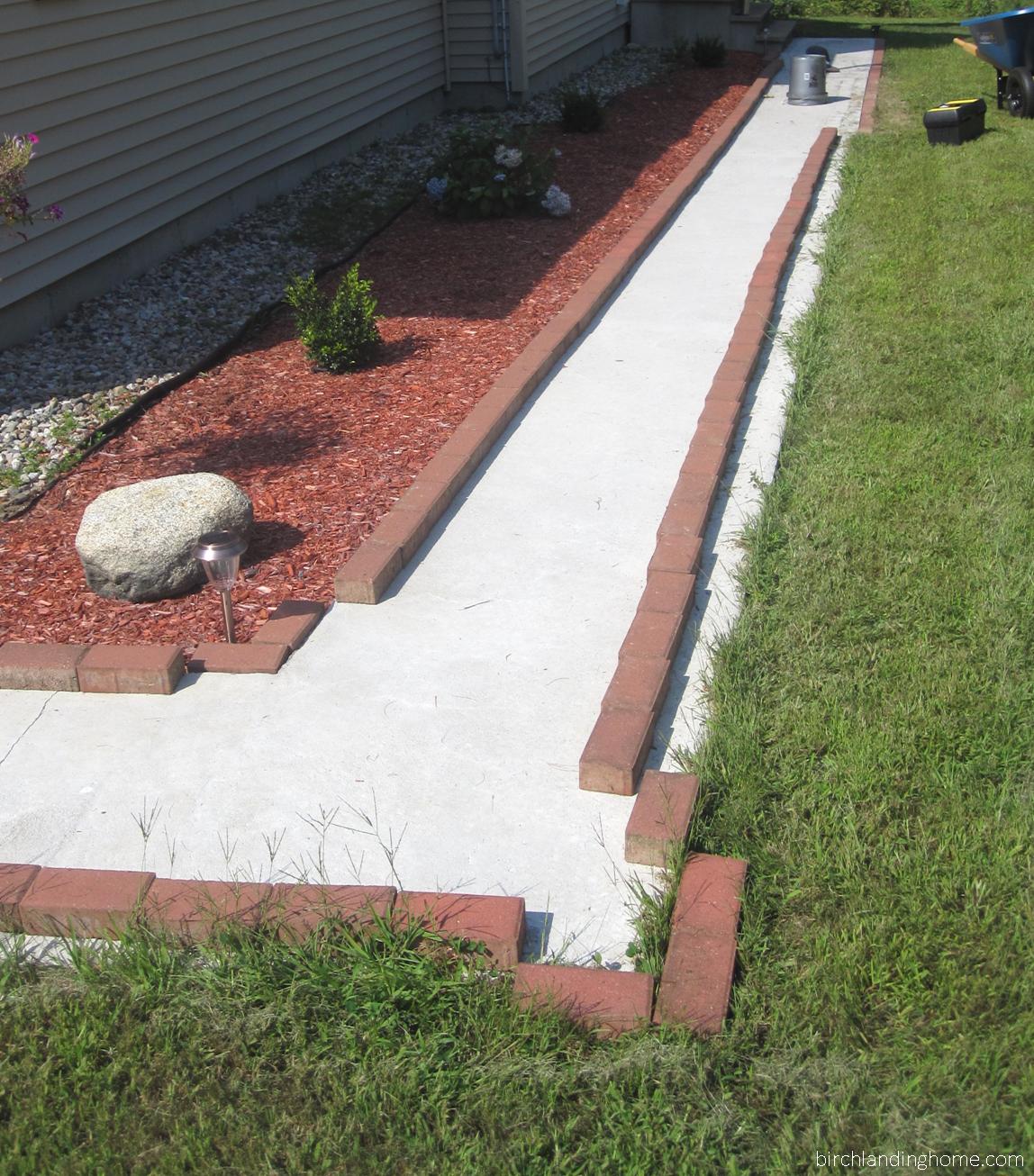
When we first moved into our home there was nothing in front of it.. no bushes or anything substantial, just a plain white concrete walkway and a bark mulch bed with a few sad daffodils that had already gone by.  It was so boring and even the walkway looked really unfinished.  

The obvious solution to dressing up the existing "flower" (I use that term loosely here) bed was to get plants and bushes in there - but what about the concrete walkway?  Luckily for us the previous homeowners had left behind a lot of bricks... A LOT.  Some were stacked under the back deck, but there was also a small random brick patio that we had plans to disassemble anyways.  There were sooo many bricks.. it was actually becoming a problem on where to store them and what to do with them.  

While trying to figure out what to do I came up with the idea of inlaying them along the walkway to dress it up a bit - and though it was a little time-consuming, the whole process was actually really easy!  

Materials:  

  • lots of bricks (enough to line both sides of the walkway, plus a few extra)
  • edger
  • wheelbarrow
  • spade
  • rubber mallet

How to:  

First I started hauling all the bricks to the front yard and laying them along the walkway to make sure I had enough (though we had so many I probably could have done this project twice!).  I started laying them out at the front steps and put them end-to-end along the whole length of the walkway, along both sides.  This way I was able to get a sense of how they fit and where I would need to do cuts (we were very lucky to have a pretty straight walkway, so the cuts needed were minimal).  If you're thinking of starting this project from scratch, I would recommend measuring the length along both sides of the walkway, then head to your local home improvement center to see what they have for bricks, their sizes, and how much they cost.  Once you decide on a brick you like, you can calculate how many bricks you will need.  

Laying out all the bricks.  You can also see our first additions to the flower bed - some tiny boxwoods and hydrangea bushes.  It's amazing how much they've grown!  

Laying out all the bricks.  You can also see our first additions to the flower bed - some tiny boxwoods and hydrangea bushes.  It's amazing how much they've grown!  

After everything was all laid out, I started by using the edger along the side of the bricks to cut the edge of the "trench" they would be set in.  I made sure not to get carried away and would only prep about two feet ahead of where I was.  I would cut as I went along to compensate for how the bricks were sitting against the walkway.  

Laying in the bricks for the DIY walkway update

Once the outside edge was cut, I would use the spade to dig out enough soil for a brick.  Then I'd set the brick in and pound on it with the rubber mallet until it was even with the grass.  Sometimes I would need to take the brick out and add or remove soil until it sat where I wanted it too.  

I continued this process along the line, brick-by-brick until I got to corners or areas where the bricks needed to be cut.  After tracing on the bricks where cuts would need to be and a quick trip to a local mason, they were cut and ready to be inlaid as well.  

Instant value and class for a worn concrete path

We have a really long walkway and I worked on this project at my leisure over the course of a week or two but probably could have gotten it done over a weekend if I had really set my mind to it.  It's definitely made a huge difference to the curb appeal of our home.  

The now-full flower beds look great next to the brick lined walkway.  

The now-full flower beds look great next to the brick lined walkway.  

Update:  This project idea was recently featured on the DIY Network Blog, Made + Remade!  You can check us out at #7 on "9 Driveway and Pathway Updates on a Budget"

KEEP UP WITH BIRCH LANDING HOME
|  Etsy  |  Facebook  |  Instagram  |  Pinterest  |  Bloglovin'  |  Hometalk  |

Update: Attack of the Garden Pests

Last week I brought you my epic battle against Japanese beetles and webworms... to update in short:  Me: 0, Japanese beetles: 1.  

So as you probably remember, I've been waging a war against some of the most annoying (in my opinion) garden pests around.  For today's update I have some good news and bad news... Good news:  there are no more signs of webworm and no further damage to our lilac bush!  Hooray!! 

Bad news:  the Japanese beetles are back and hungrier than before.  First I tried brushing and picking them off my plants and dropping them in a bucket of soapy water.  The results were instantaneous and I would have been hard pressed to find any beetles left on my plants by the time I was done; I also set up a Japanese beetle trap away from the garden and caught many bugs right away.  I thought I was in the clear but decided to wait several days to see how things went.  

Nearly a week later I'm back to report on my progress - I haven't touched the bean plants at all because I wanted to see if my efforts had any lasting effect.  And folks, I'm here now to tell you.. it didn't.  The trap has in fact caught more beetles, but it's not an outrageous amount (there's maybe 1-2 inches of beetles in the bottom of the trap, we caught about 1 inch of beetles within the first day) and my bean plants are suffering more damage by the day!  There are less beetles on them than there were a week ago, but they certainly found their way back and seem to be doing even more damage than before.  

Japanese beetles eating our plants

In conclusion, next time I'll save my money and skip buying the Japanese beetle trap.  I'll stick to taking the beetles off the plants dropping them in a bucket of soapy water, though this process will have to become a daily one at our home until those pesky beetles are gone for good.  

KEEP UP WITH BIRCH LANDING HOME
|  Etsy  |  Facebook  |  Instagram  |  Pinterest  |  Bloglovin'  |  Hometalk  |

Attack of the garden pests!

For the past week at Birch Landing Home, we've been under attack - first by an absurd amount of Japanese beetles, and then by webworms!  Yuck.  
Read on for tips on how to combat these awful garden pests...

Combating Common Garden Pests:  Japanese Beetles and Webworms / Tent Caterpillars

Japanese Beetles

Earlier in the week, I went in the garden to check how everything was doing.  I was greeted with THIS:  

Japanese beetles eating and ruining my plants

Japanese beetles were all over my beans, eating the leaves until there was nothing left.  They were doing so much damage and I was not happy!  

Unfortunately with Japanese beetles, when there's one he'll tell all his friends (via pheromones) and more and more will come.  Obviously these beetles told everyone in the tri-state area to come and bring a friend.  

The best way to get rid of them is to pluck them off by hand and throw them in a bucket of soapy water to kill them.  The quicker they're gone and not releasing pheromones, the less beetles will find your yard.  Plucking beetles was not something I wanted to do, but you gotta do what you gotta do.  

Another popular solution is to put a beetle trap in your yard.. though some people argue that they can actually make the situation worse since they lure beetles to the trap (and therefore your yard).  I was desperate though and figured I might as well give the trap a shot too.  I made sure to put it away from the garden and away from where we usually spend time (the lure is poisonous, keep that in mind).  Right away we caught quite a few beetles!  I'm sure these first ones were in the yard anyways and not ones that we lured in.  

Bag-a-bug Japanese beetle trap

We'll see if there's improvement.. I'll post an update on the Japanese beetles in a few days.  


Webworms (aka Tent Caterpillars)

Then just when I thought I was getting a grasp on the Japanese beetle plague, I noticed webworm (also known as tent caterpillars) nests in one of our lilac bushes.  These little baby caterpillars were already doing a number on the lilac bush, eating the leaves and smaller stems down to nothing.  These buggers had to go too.  

Webworm (aka tent caterpillar) nest.  The web keeps them safe from predators so they're free to make quick work of your foliage.  

Webworm (aka tent caterpillar) nest.  The web keeps them safe from predators so they're free to make quick work of your foliage.  

A close up of the damage.. as you can see it's on multiple branches.  

A close up of the damage.. as you can see it's on multiple branches.  

The best way to get rid of these is to cut out the nest if possible, and then destroy it.  Luckily these nests were towards the ends of branches, so they were relatively easy to cut out.  (If you have a nest that can't be cut out, you can tear the nest open using a stick and hope that some birds or other bugs find the little caterpillar snacks.)

Hard to believe these teeny-tiny caterpillars can do so much damage!  

Hard to believe these teeny-tiny caterpillars can do so much damage!  

Once the nest is out you can put it in a sealed container and throw it away.  I didn't have any Tupperware or large jars I was willing to toss so I put the nest in a zip-lock, triple-bagged it, and threw it in the trash.  Some people recommend burning the nest, which might be a good option if you have a lot of nests to destroy.  

Cut out the webworm / tent caterpillar nest and seal in a plastic bag to dispose of it

Another solution some people use is spraying the affected area with Neem.  It kills the caterpillars and is considered an all-natural insecticide.  I'm hoping that just cutting out the nests and staying on top of it will do the trick though.  

The damage to the lilac bush has been done, but I'm optimistic it will bounce back.  And in the meantime I'll keep a close eye on it in case any other webworm nests pop up.  

KEEP UP WITH BIRCH LANDING HOME
|  Etsy  |  Facebook  |  Instagram  |  Pinterest  |  Bloglovin'  |  Hometalk  |